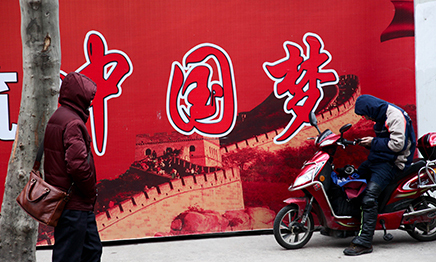
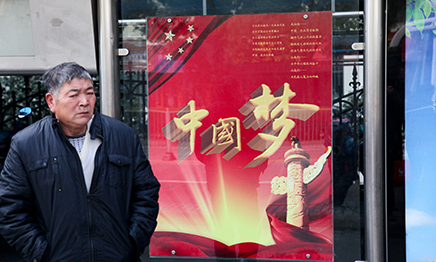
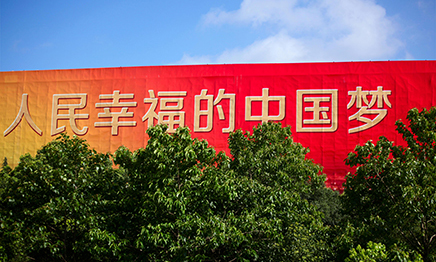
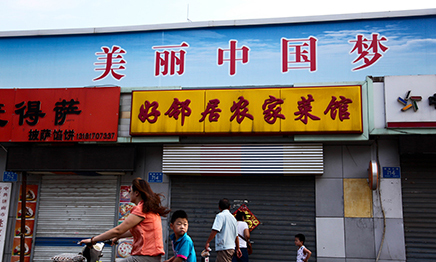
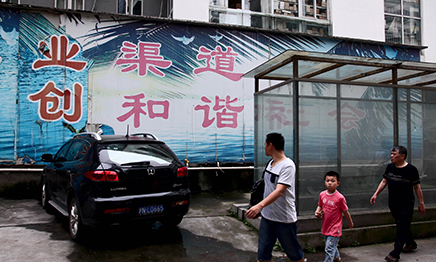
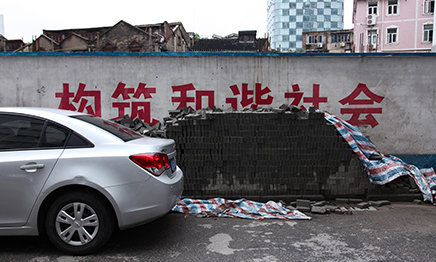
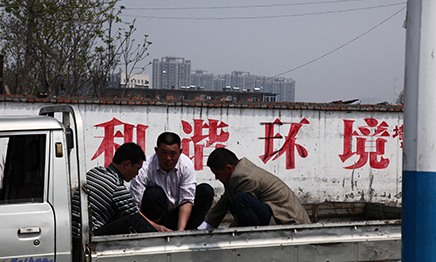
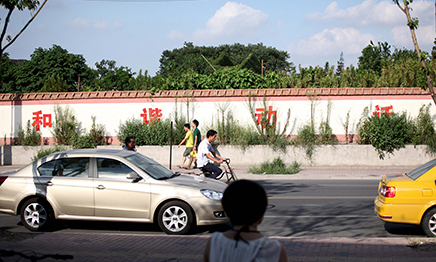
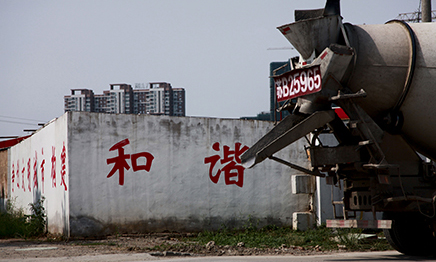
Key Words, a series of photographs, is a type of photography concerned with contemporary society’s ‘slogan landscape,’ or to put it another way, with core mainstream discourse and their record of a moment in time. One might say that every nation’s historical stages of development can be summarized with keywords coined in the moment of social movements. In China, slogans act alongside magazine publications and television broadcasts as a form of mainstream publicity, infiltrating every corner of society. Yet, in any specific historical period, you can discover, examine and recognize in the midst of the vast majority of slogans the current society’s ‘key words’. Key words are the refined and concentrated expressions of society. Actually, this is an example of a ‘language event’. It is both timely and brings a sense of immediacy to information. Therefore, my lens aims to capture these ‘Key Words’ and juxtapose or intertwine the ‘scene’ of each key word. In the process of taking a photograph, I discover that in fact the traces of the contemporary locus of mainstream history (the historicity of the present moment) are represented by these key words. Mainstream discourse and their referents both act as the creators and witnesses to history. What I really find interesting, is not the dull chronology these words participate in, but how these words act as commentators and carriers of news of common scenes of social activity.
The‘Development is the Most Important Principle’ is an example of a ‘language event’ chronicling China’s reformation and opening up (the grand traces of mainstream history). Taking correction and clarification of the incomplete record of the stubborn ideology of the ten years of cultural reform, this phrase has lead people from revolutionary activities to economic development. These words constitute an ‘activity’, an example of the national effect of the influence of the language of new ideological conditions, activities of the nature of dynamic economic advance. Through every image of ordinary scenes in Key Words- Development, we can associate the history of the struggle to increase our own GDP, associate the time-consuming struggle between capitalism and socialism, associate the lively scenes of construction across the nation, and make associations with environment concerns, resources, trade, international linkages, good faith and other key words in the background of the ‘historical image’.
However, ‘harmony’ is found in each person’s experience of ‘immediate history’. It is the follow-up to ‘development’, and belongs in the same context as ‘development’. ‘Harmony’, another example of a language event, is even more relevant to the issues affecting contemporary Chinese society, as well as methods to solve its problems. This is either a question of ‘development’ or the legacy of ‘excessive development’. Yet, the method of solving the problem is repeatedly raising the value in people’s perceptions of Chinese traditional moral theory and culture. Through the lens, we can see behind Key Words- Harmony, the emergence of the different expressions belonging to every strata of society. We can see the comical juxtaposition of harmony and conflict, see in a thriving national chronology, a colorful unofficial history of the people.